The Meta-Maths Method
Curriculum-aligned maths, taught through explicit metacognition, verbal reasoning and confidence building.
Written in response to a pattern
The Meta-Maths Method came out of seeing the same thing again and again, in mainstream provision and in private tutoring alike. A heavy reliance on procedural teaching, with very little attention paid to mathematical thinking.
The result is a familiar kind of learner. They can reproduce a procedure in a context they recognise, but not when the structure of the question shifts, or when reasoning is required, or when they have to explain what they have done, or when the pressure goes up.
So the programme moves deliberately away from answer-getting, from speed as the measure of success, and from passive worksheet completion. It moves towards explanation, comparison, and flexible choice of strategy.
The belief underneath all of it is simple. Confidence and understanding are the same problem. Children who understand maths deeply become more confident, and children who feel safe become willing to attempt maths that is hard.
Principle one
Confidence first, which is not the same as lowering the bar
We build lessons where mistakes are treated as useful information, where struggle is expected rather than hidden, where thinking is valued above speed, and where a child will attempt something unfamiliar without fear of getting it wrong in front of other people.
Tutors are trained to find what is mathematically valid in an attempt before addressing what has gone astray. It keeps a child in the conversation instead of closing them down, and it still gets them to the right answer. It simply takes the longer route, which is the route that sticks.
We pay particular attention to children who avoid risk, who rush because they are overconfident, who shut down after a mistake, or who have quietly concluded that being good at maths means being fast.
The single most useful word in our vocabulary is "yet". "I can't do this" becomes "I can't do this yet", and the whole sentence changes meaning.
Principle two
The Four Thinking Blocks
These are not four separate lessons. They are four questions running underneath every lesson, and they are the vocabulary we use when we write to you each week. It means progress gets described in terms of how your child is thinking, not only which topics were covered.
Noticing Structure
Spotting patterns and relationships, so that maths makes sense rather than being memorised. A child who notices that 47 plus 38 is one less than 47 plus 39 has understood something that no amount of drilling would have given them.
What do I see?
Checking Strategies
Improving work through reasoning and estimation, rather than finishing and hoping. Children learn to ask whether an answer is even plausible before they ask whether it is right.
Does it make sense?
Representing and Explaining Ideas
Showing thinking clearly with drawings, models and words before moving to abstract methods. Bar models, place value representations and structured diagrams do most of the heavy lifting here, particularly with fractions and word problems.
How can I show it?
Planning and Persistence
Planning the steps, and staying with a multi-step problem past the point where it stops being comfortable. This is the block that transfers furthest beyond maths.
What is my strategy, and how do I keep going?
What actually happens in an hour
Lessons follow a deliberate shape. Retrieval, then representation, then application, then evaluation.
Retrieval practice connected to earlier work. Typically phrased as a challenge rather than a test. "Give me two different ways to work this out in your head, and tell me which one you would trust under pressure."
The new idea arrives as a picture before it arrives as a number. Bar models, visual partitioning, structured diagrams. The opening question is nearly always the same one, and it is deliberately open.
The tutor models the thinking out loud, including the false starts and the checking, not just the tidy method. Then children work, first together and then independently, moving from varied fluency into reasoning and unfamiliar contexts.
A deliberate misconception goes on the board and the group takes it apart together. Which strategy was most efficient? Why does this always work? What mistake might somebody make here, and why is it a reasonable mistake to make?
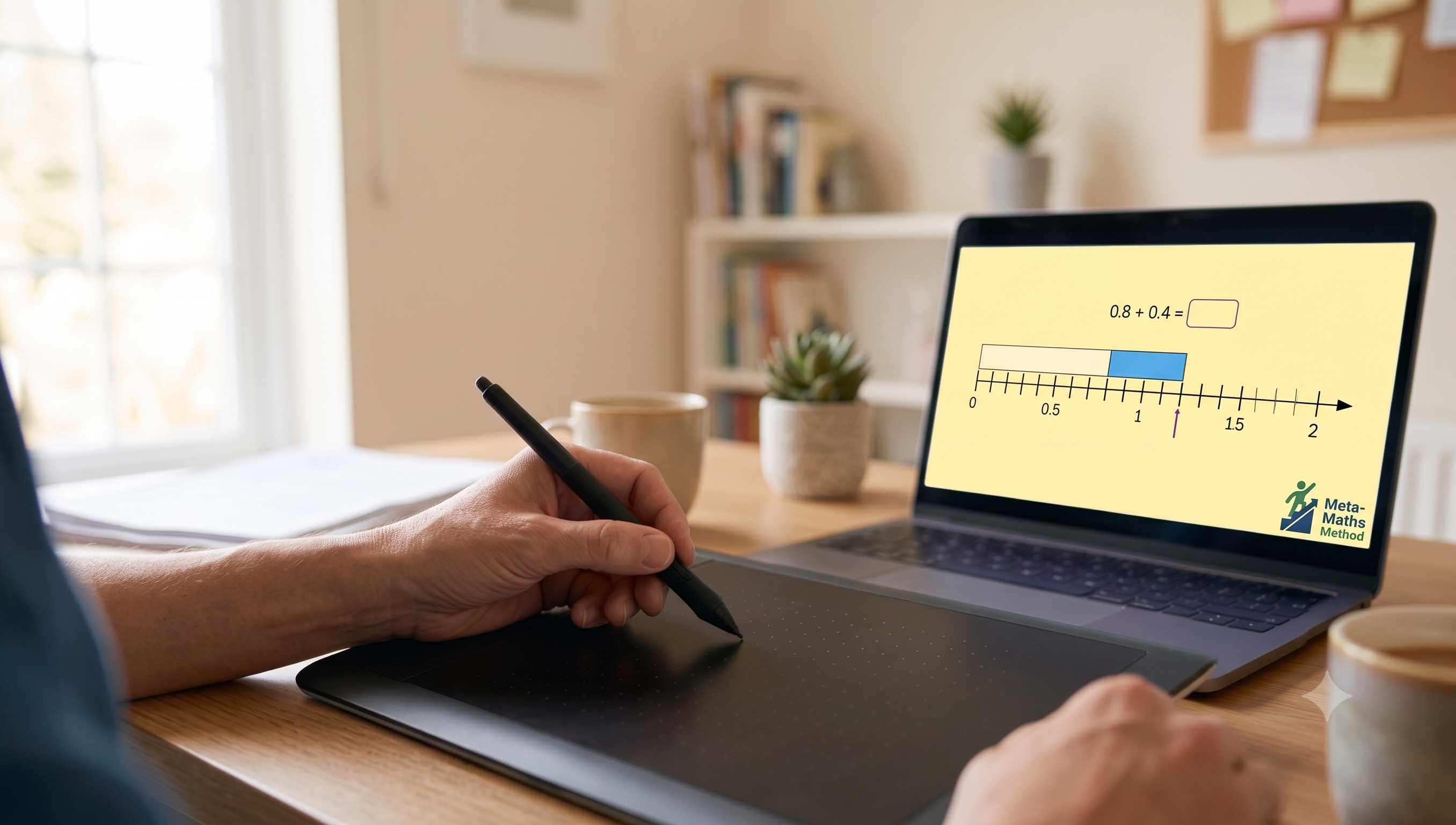
Lessons run on Zoom, with live annotation from a graphics tablet. Cameras on, and every child expected to speak. The discussion is not a warm-up for the lesson. It is the lesson.
Principle three
Why groups of three to five, and not one to one
One to one tuition is often assumed to be the premium option. For what we are trying to build, a small group does things that one to one cannot easily reproduce.
Children hear methods that are not their own. They critique reasoning out loud. They explain an idea to somebody else, which is the fastest available test of whether they actually understand it. And they watch another child be wrong, think again, and arrive somewhere better, which is worth more than being told that mistakes are useful.
Just as importantly, they get comfortable being wrong in front of other people and revising their thinking. That is a skill they will use in every classroom they ever sit in, and it is very hard to practise alone.
Five is the cap, and it is a hard cap. Every child is heard in every lesson, and a misconception gets caught in the moment it appears rather than a fortnight later.

Aligned to school, informed by research
Sequencing follows White Rose progression models, which keeps our lessons coherent with what is happening in your child's classroom and reduces how much they have to hold in their head. We also draw on National Curriculum expectations, GL Progress Test structures and the reasoning demands of SATs style questions.
This is not a narrow test preparation model. Test performance tends to follow understanding, so we work on the understanding and let the scores catch up.
Where the thinking comes from
The programme has been shaped by the work of Craig Barton, Jo Boaler, White Rose Education and Claire Gadsby.
What that looks like in practice
Retrieval practice, mastery learning, metacognition, structured variation, worked examples and genuine mathematical discussion.
Sound like the right approach for your child?
Send us a few details and we will arrange a short, informal call. If we do not think this is the right fit, we will say so.
© 2026 The Meta-Maths Method. Operated by Sharper Thinking Maths FZE. All rights reserved.