Sharper thinking,
stronger maths.
Small-group online maths tuition for Years 3 to 7, built around how your child thinks rather than what they can remember.

Most maths tuition teaches children what to do. Very few teach them how to think.
You might recognise some of this.
- They follow the method in the lesson, then cannot do it a week later.
- They check with you after every step.
- They are quick and accurate, until the question is worded differently.
- Homework ends in frustration, or in silence.
There is usually one thing underneath all of it. Children are handed procedures to copy instead of structures to understand. That works while the questions look familiar. It stops working the moment they don't.
Speed is not the same as understanding. A child who has learned to fear being wrong will stop trying long before they run out of ability.
Our approach
We teach children to think about how they think.
The Meta-Maths Method is grounded in Carol Dweck's Growth Mindset research, and it is deliberately metacognitive. In practice, lessons keep returning to four questions. How did you know? Could this be solved another way? Which strategy is most efficient here? What mistake might somebody make?
Children explain their reasoning out loud. They compare strategies. They look at a deliberate misconception and work out why it is wrong. Over twelve weeks that changes something more durable than a topic score. It changes how a child approaches a problem they have never seen before.
We normalise struggle rather than rescuing children from it. Challenge is information, not failure.
The Four Meta-Maths Thinking Blocks
Every 12 week cycle moves through the same four ways of thinking. They are also the language we use when we write to you about how your child is getting on.
Noticing Structure
Spotting patterns and relationships, so that maths makes sense rather than being memorised.
What do I see?
Checking Strategies
Improving work using reasoning and estimation, instead of hoping the answer is right.
Does it make sense?
Representing and Explaining Ideas
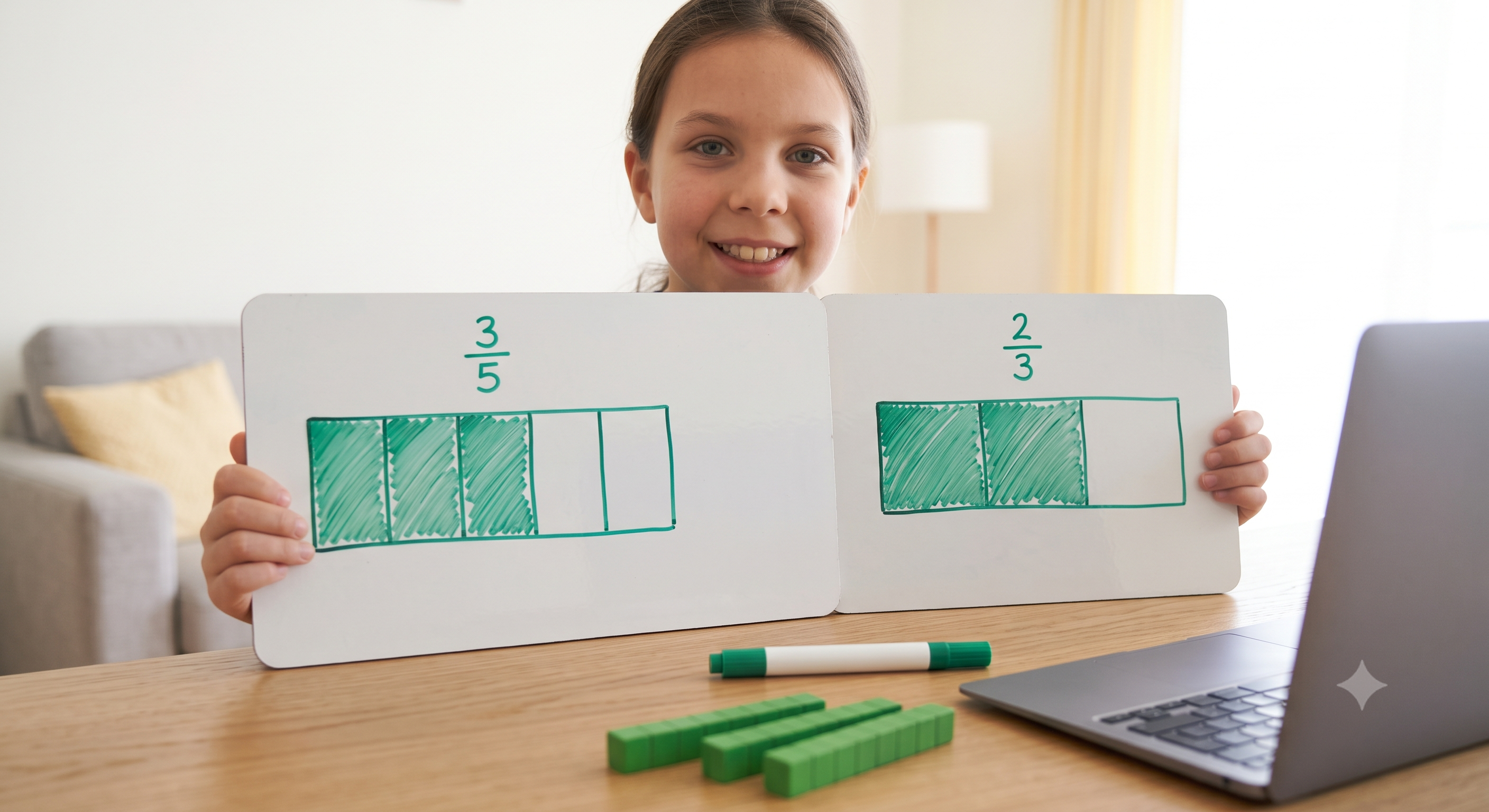
Showing thinking clearly with drawings, models and words before moving to abstract methods.
How can I show it?
Planning and Persistence
Planning the steps, and sticking with a multi-step problem when it feels tricky.
What is my strategy, and how do I keep going?
A structured 12 week programme, not ad-hoc tutoring.
Groups of 3 to 5
Small enough that every child is heard in every lesson. Big enough that they hear other children reason aloud, disagree, and change their minds, which is where a good deal of the learning happens.
Two live lessons a week
One hour each, online. The first secures the core. The second goes deeper and extends.
It opens with a diagnostic
A 30 to 45 minute one-to-one assessment before the programme begins. Not to produce a score, but to find the misconceptions, the confidence patterns, and the five goals we will work towards.
Tracking shared with you
You'll receive a link to a live document telling you what your child has been learning, their wins and what they need to focus on next.
Three children we tend to help most
The child who is doing fine on paper
Quick, accurate, gets the ticks. Works at surface level, avoids anything unfamiliar, and has never really been asked to explain why a method works. We give them something to think about.
The child with gaps underneath
Place value that never quite settled. Fractions that connect to nothing. Knowledge that does not transfer between contexts. Rushing them forward will not help, so we rebuild the structure properly.
The child heading to secondary
The pace picks up, more independence is expected, and confidence often dips at precisely the moment the demand rises. We build the reasoning and the resilience before it is needed.
What parents say
"I was worried she would lose her interest in maths. Now she says maths isn't what she hates anymore."
"She wasn't happy about taking maths classes at the beginning, but now she enjoys them and doesn't complain at all. I like that it's one concept per class, presented in a clear and simplified way."
The founder
Taught by someone who found maths hard too
I loved maths as a small child. Then I met the rules, long lists of procedures that nobody explained, and it stopped making sense. It took until my teacher training to sort out, when maths became my specialism and I finally went looking properly. There had never been only one method.
Twenty-five years of primary teaching later, in the UK and internationally, I am certain of one thing. Almost every child can succeed in maths, given the right foundations and the right direction.
Alf Collett, Founder
Tell us about your child.
Send a few details and we will arrange a short, informal call. The first conversation is only about understanding where your child is, and whether this is the right fit.
© 2026 The Meta-Maths Method. Operated by Sharper Thinking Maths FZE. All rights reserved.